
Slide Writing
Best Tools and Templates for Business Case Presentations in 2026
In this article, we look at the best tools to help you create executive-level business cases based on the McKinsey standard.
Sep 7, 2026
Problem-solving—finding the best solution to a business opportunity or challenge—is at the heart of how management consultants create impact for their clients.
At top consulting firms like BCG, Bain, and McKinsey, there’s a proven method of problem solving that every associate learns from day one—a structured, step-by-step approach that can be applied to almost any business problem.
This post will guide you through that approach, offering practical tips, tricks, and free templates so you can start applying these techniques right away.
There are a number problem solving approaches being used at top firms, each suited for different types of problems.
This article focuses on the hypothesis-led approach—the BCG and McKinsey go-to method for addressing most business challenges—which emphasizes forming and testing hypotheses to arrive at impactful solutions efficiently.
The hypothesis-led problem-solving approach is particularly effective when problems are complex and data may be incomplete, such as market entry strategies, business strategy development, mergers and acquisitions, and operational improvements.
Here are the seven steps involved in this process:
Please note that although these steps are listed in order, problem-solving is not a straight line. Think of it as an iterative process where you quickly develop early hypotheses and solutions and continually refine them.
Let’s go through the seven steps in detail one by one:
The problem solving process starts with a clear and thorough definition of the problem and the end goal.
It’s tempting to rush this step—perhaps you think you already know the solution, or you believe the problem was already clearly outlined in the project assignment, or you feel pressured by stakeholders to proceed quickly. And while all these reasons might be valid, many unsuccessful projects stem from not having a clear definition of the problem and a shared understanding of what success looks like.
Great problem solvers take the time to establish a precise and comprehensive definition of the real issue at hand. And they make sure that this definition is understood and agreed upon by all relevant stakeholders as well as within the project team.
To define the problem effectively, we recommend using the Problem Statement Worksheet (can be found here). It looks simple, but it is very effective.
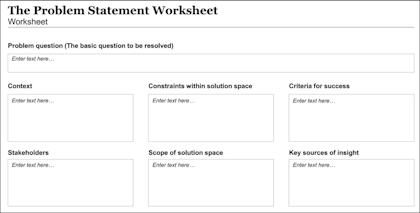
By thoroughly working through the Problem Statement Worksheet, you set a strong foundation for the rest of the problem-solving process, ensuring that everyone is aligned and focused on delivering the right solution.
If you are unclear about an element of the Problem Statement Worksheet, it will almost always result in ‘scope creep’ or unaligned expectations.
A few tips on how to maximize the value of the Worksheet:
After defining the problem, the next step is to structure the problem effectively. This involves breaking down the main question into smaller, manageable parts that can be analyzed and addressed.
Two powerful techniques for this are hypothesis trees and issue trees.
A hypothesis tree is a structured tool that breaks down your main problem into a hierarchy of testable hypotheses. Starting from the main question, you systematically decompose it into smaller, more manageable parts that can be individually analyzed and validated.
This approach helps you focus your efforts on the most critical areas, streamline your analysis, and move efficiently toward a solution.
Example:
If the primary question is, “How can Airline Inc. reduce operating costs by $400 million through more efficient and effective operations before 2027?” you might develop the following hypotheses:
Each of these hypotheses can then be broken down further and tested through analysis.
What makes a good hypothesis?
A strong hypothesis should:
When you don’t have enough information to form specific hypotheses upfront, an issue tree is an effective tool to break down the main problem into key questions that need answering. Issue trees help you systematically explore all aspects of a complex problem by decomposing it into smaller, manageable issues or questions. This approach ensures that you cover all possible angles and don’t overlook any critical factors.
Example:
Continuing with the operational costs of Airline Inc., your issue tree might look like this:
Tips for Effective Issue Trees:
After breaking down the problem into hypotheses or key issues, the next step is prioritizing which ones to tackle first. Effective prioritization ensures that your efforts are focused on the areas that will deliver the most significant impact.
A common tool for prioritization is the two-by-two matrix, which helps visualize and compare different issues based on specific criteria.
Choose two criteria that are most relevant to your project’s success. The most frequently used axes are:
Other commonly used prioritization criteria include urgency, fit with values and mission, strategic alignment, and fit with capabilities. Applying some of these prioritization criteria will typically knock out portions of the issue tree altogether, enabling you to focus your efforts where they matter most.
With your prioritized list of key issues or hypotheses, the next step is to design an effective work plan outlining how you’ll conduct the necessary analyses to address each issue plan the analyses needed to test these hypotheses and develop solutions.
Turning your prioritized problems into a work plan involves two main steps:
First, define the tasks that need to be completed. Whether you’re starting from issues or hypotheses, clearly outline the desired outcomes and the analyses required to achieve them. Also, estimate the data sources, timing and who will be responsible for each.
Next, organize these tasks in a timeline that aligns with available resources and key project milestones (like important meetings or progress reviews). Make sure the sequence fits the overall pace of the project, such as weekly or bi-weekly meetings.
After putting together your work plan, the next step is gathering data and conducting analyses to solve the problem at hand. This step typically takes up most of the time spent on a consulting project.
While this guide doesn’t aim to teach you how to collect data or perform analyses, it’s important to emphasize that at McKinsey, quantitative data is paramount. Any solution not backed by solid numbers carries a heavy burden of proof. If data isn’t readily available, you must generate it yourself—whether through interviews, surveys, or constructing models.
Tips for this step
After diving deep into data and analysis, it’s essential to step back and identify what’s truly important. This is often the most challenging part of problem-solving. Effective problem solvers look for the core message that will support a clear recommendation.
At firms like McKinsey, BCG, and Bain the Pyramid Principle is used to synthesize findings. This principle states that every synthesis should communicate one main idea—the “governing thought.” Supporting ideas are organized logically, moving from detailed facts up to the main conclusion, while excluding irrelevant information.
Even though synthesizing formally comes near the end of the problem solving process, it’s something you should do continuously throughout the project. After making any analytical progress, try to create an initial “Day 1” or “Week 1” draft of your solution and revisit it regularly—testing and adjusting both your answers and your approach at each phase. Regular synthesis helps keep your team focused on the key question and ensures you’re always ready to communicate your findings.
This step involves translating your overall solution into specific actions that will deliver impact.
This is where we answer the main question: “What should we do, and how should we do it?”
While thorough analysis is important, it has little value if it doesn’t lead to actionable recommendations along with a plan and leadership commitment to implement the plan.
Steps to develop effective recommendations:
When building your recommendations, consider these questions:
If the answer to any of these questions is no, ensure your recommendations address these issues. By doing so, you’ll increase the odds of achieving results.
Tips for Synthesizing findings
A powerful way to synthesize the overall story is to structure your synthesis using the 'Situation, Complication, and Resolution' framework (SCR framework).
Example:
Situation: “The airline industry is under pressure to reduce costs due to rising fuel prices, increased competition, and post-pandemic recovery challenges.
Complication: “Airline Inc.’s operating costs are significantly higher than industry benchmarks, threatening profitability and limiting its ability to invest in growth opportunities.”
Resolution: “Airline Inc. should implement a comprehensive cost-reduction strategy targeting $400 million in savings by 2027, focusing on fleet optimization, operational efficiency, supplier renegotiations, and technology-driven automation.”
Effective problem-solving is closely linked with communication. Throughout the problem solving process, maintain open lines of communication with team members and stakeholders. Share your draft solutions to ensure they’re practical and impactful—not just good on paper. Co-creating the solution with relevant stakeholders sharpens the outcome, uncovers potential issues early, and fosters ownership of the final recommendations.
It is a seven-step, hypothesis-led method: define the problem, structure it, prioritize issues, plan the analysis, conduct the analysis, synthesize findings, and develop recommendations. BCG and Bain work the same way. The method’s power is that it starts from an answer to test rather than an open-ended search.
A one-page tool that forces precision before work begins: a SMART main question, context, success criteria, scope, constraints, and stakeholders. Most failed projects we saw in our McKinsey and Bain years traced back to skipping this step.
You form an early answer, structure it as a hypothesis tree, and direct all analysis at proving or disproving the branches. The article’s Airline Inc. example splits a 400-million-dollar cost reduction goal into hypothesized savings of 150 million from fleet, 120 million from operations, 80 million from procurement, and 50 million from technology.
With a two-by-two matrix of impact versus ease of implementation, and the 80/20 rule: focus on the 20% of analysis that delivers 80% of the solution. Exhaustiveness is for the issue tree, never for the workplan.
Imagine you can only list three to seven actions that come out of your project, and write these down. If you find it difficult, narrow it down to the one most important change that should come out of your project. Synthesis is a distinct step; a list of findings is not yet an answer.
Hope you enjoyed this post. If you’re interested in diving deeper into related concepts, check out these insightful posts: